
Understanding Carter County Releases
A release from Carter County Jail is the end of that jail's hold, but it does not always mean a return to the community. A person may leave on bond, after time served, under a court order, or after a case disposition. The jail may also discharge the person to the Oklahoma Department of Corrections, another county, the U.S. Marshals Service, or immigration custody. That movement is a transfer. The Carter County jail register is the best local record because Oklahoma law calls for the available register to show the date or manner of discharge or escape.
The official sheriff roster answers a narrower question: who is in Carter County custody now. It is updated hourly and removes people who leave custody. An absent name is therefore a lead, not proof. A complete Carter County release check pairs the sheriff's register entry with the court case and, when needed, ODOC, VINE, BOP, or ICE information.
- Discharge
- The recorded end of one custodian's hold.
- Transfer
- A move to another authority while custody continues.
- Time served
- Release after the credited custody term is complete.
- Detainer
- A request or legal basis for another authority to take custody.
Carter County Release Paths
The reason for discharge controls the next search. Bond permits a person to leave while the case continues. Time served closes the custodial part of a sentence but may not end every court duty. A transfer closes the Carter County booking without ending custody. Parole places a state prisoner in the community under conditions, while probation is a court-ordered form of community supervision that may occur without a prison release.
| Event | Meaning | Next record |
|---|---|---|
| Bond release | Community release while the case remains open | Jail register and OSCN docket |
| Time served or court release | Local custody ends under the sentence or order | Jail register and court disposition |
| ODOC transfer | State custody begins or continues | ODOC offender search |
| Parole | Community release under ODOC supervision | ODOC status and PPB decision record |
| Federal or ICE handoff | County hold ends, another hold may continue | BOP, actual USMS custodian, or ICE locator |
Carter County Release Record Fields
A useful request identifies the exact booking and asks for the available jail-register entry. The sheriff may also keep a booking sheet, release or transfer document, and photo. Availability is not identical for every item, so the mandatory register fields should be separated from optional records. The court docket can explain the legal event, but it does not provide the jail-door time.
| Field | What it shows |
|---|---|
| Name and identifiers | Connect the record to the correct person |
| Booking number and date | Tie the discharge to one custody episode |
| Committing authority | Identify the agency or court behind the hold |
| Date or manner of discharge | Show when or how Carter County custody ended |
| Release type or disposition | Distinguish bond, time served, court release, or transfer when retained |
| Receiving authority | Show where custody continued if that information is public |
A blank or missing roster card does not prove community release. Ask whether the discharge was a release or a transfer.
Request Carter County Release Records
The Carter County Sheriff records page directs requesters to call for the form during normal weekday business hours. The office publishes a $5 report fee and generally requires completed records to be picked up. Its page also notes that some reports may be emailed and that some material requires a subpoena. Ask which rule applies before traveling.
- Identify the person, aliases, approximate booking dates, and any known booking or case number.
- Call 580-223-6014 and request the current form for a jail-register or booking-and-release record.
- Ask for the date and manner of discharge, booking data, release or transfer record, and receiving authority if public.
- Request the booking photograph separately if it is kept and releasable.
- Confirm the fee, payment form, pickup method, identification rule, and whether the record is ready before visiting.
100 S. Washington
Ardmore, OK 73401
580-223-6014
The records screenshot below comes from the official sheriff request page.
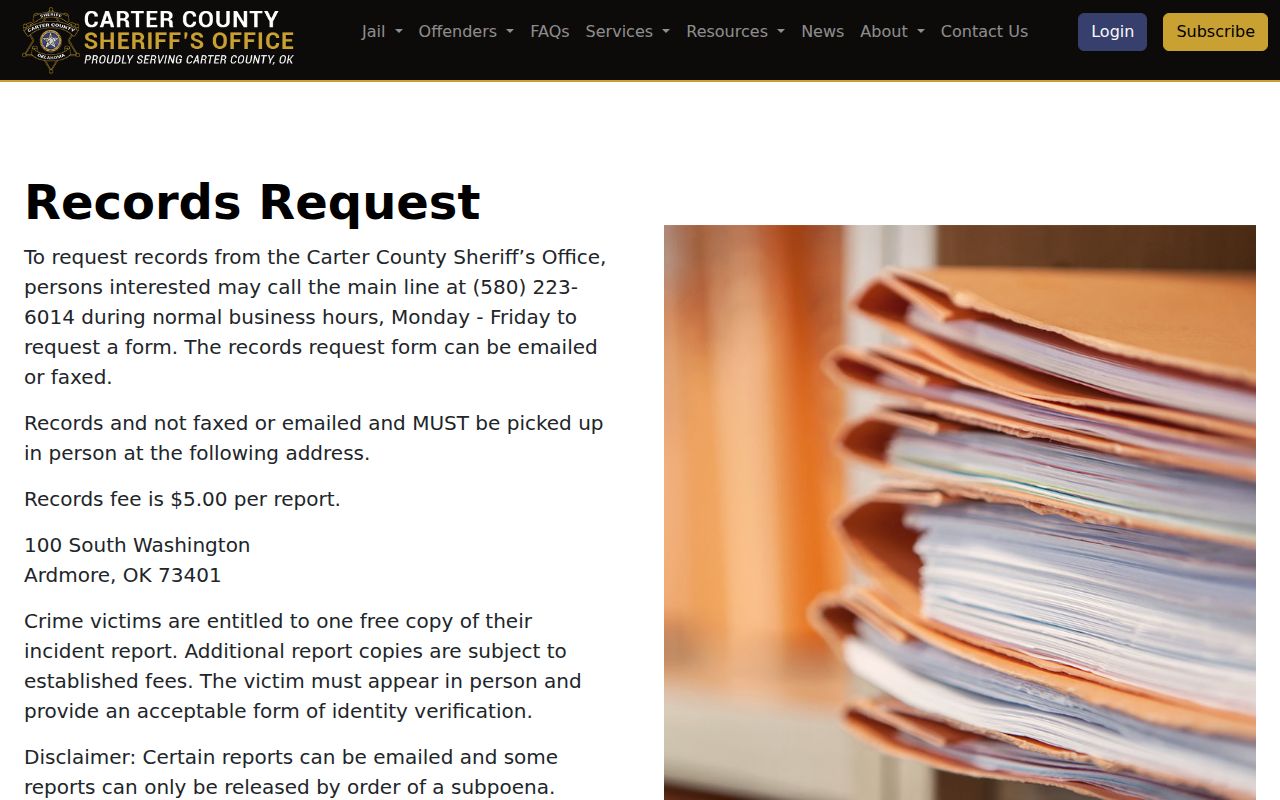
Its form, fee, and pickup language make a call before travel especially useful.
Oklahoma Law on Carter Releases
The Oklahoma Open Records Act begins at 51 O.S. §§24A.1 et seq. Section 24A.5 sets the general inspection and copying framework. The local anchor is 51 O.S. §24A.8, which includes the date or manner of discharge or escape among available jail-register information. Public portions should be separated from material that is lawfully withheld.
Juvenile, sealed, expunged, medical, security-sensitive, and protected investigative material can be restricted. Oklahoma expungement procedure is governed by 22 O.S. §18 and §19. A missing online result can reflect sealing or another limit, so absence still does not prove that no booking existed.
Carter County Bond Releases
The Sheriff's registered-bondsmen page adds a local warning: improperly completed or notarized bonds will not be accepted, and a case number must be included once a case is filed. A successful bond ends the immediate jail stay, not the criminal case. Defective paperwork can lead to re-arrest. The OSCN docket should therefore be checked after the jail register confirms the bond discharge.
The official bond page is shown below because its paperwork warning changes how a same-day Carter County release should be read.
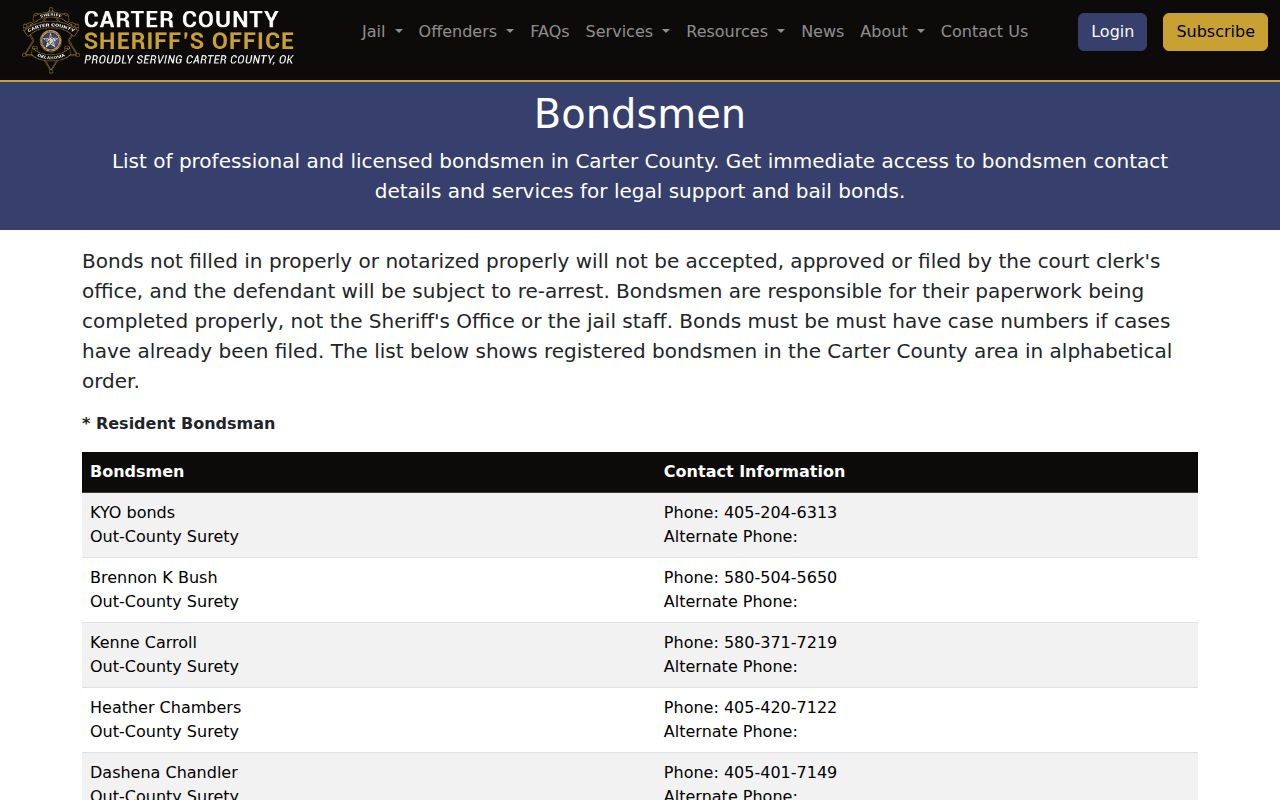
The case remains active unless the court record shows a final disposition.
Find Carter County Released Inmates
Start with identity, not assumptions. Names may match, and a person can have more than one booking. The sheriff's active roster is useful for ruling in present local custody, while the jail register, VINE event, and docket answer different parts of a past release. For a person transferred to ODOC, the state number becomes the most reliable identifier.
- Search the Carter County inmate roster. A current card supports present local custody.
- If no card appears, check the exact person through Oklahoma VINE and read whether the event says release or transfer.
- Search Carter County in OSCN for bond, judgment, dismissal, sentence, warrant, or transfer context.
- If the case shows an ODOC sentence, search the ODOC number or full name in the state offender system.
- If federal or immigration custody appears in the case or holding authority, use the correct federal locator.
- Request the sheriff jail-register entry for final local proof of date and manner of discharge.
For a county-wide interval rather than one name, use a bounded Carter County 24-hour records request. Carter does not publish an official recent-release feed.
ODOC Carter Release Search
The Oklahoma Department of Corrections offender search applies only when a person entered ODOC custody or supervision. It is not the archive for an ordinary county bond release. Search results are abbreviated and may show an offender number, name, photo, offense information, custody or supervision status, and a projected release date where the live record makes that field public. A projection is tentative, not an actual discharge.
| Search item | Use | Limit |
|---|---|---|
| ODOC number | Best match for a known state record | Does not cover county-only custody |
| First and last name | Find possible state matches | Compare identity fields carefully |
| Status or location | Distinguish custody from supervision or discharge | Labels must be read in the live record |
| Projected date | Agency estimate when displayed | Can change and may be confidential in detail |
The direct ODOC search screen can be reviewed at its official source.
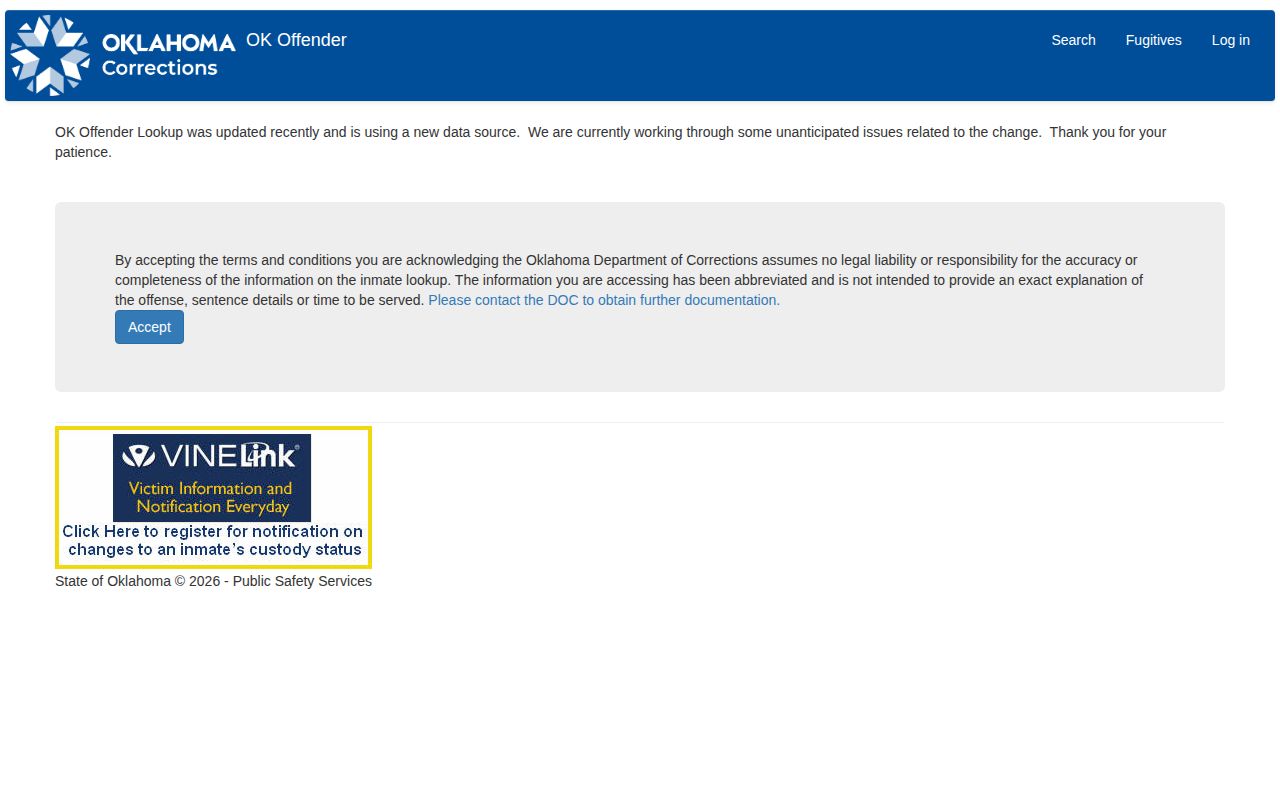
The disclaimer is a reminder to verify any abbreviated result with ODOC or the underlying court record.
Three Offices Track Carter Releases
An Ardmore arrest can create three separate record trails. The Ardmore Police Department controls the city incident or arrest report. The Carter County Sheriff controls the jail booking and physical discharge record. The Carter County court docket preserves legal steps such as bond, plea, dismissal, judgment, sentence, revocation, or amended orders. One office may give a correct answer that does not answer the whole release question.
The OSCN Carter County search provides the online legal trail.
A docket order supports the reason for release, while the sheriff register supplies the custody endpoint.
Carter Release Window Requests
Carter County does not publish an official 24-hour list, 72-hour list, or released archive. A precise window can still be requested from the sheriff's jail register. State the local start and end timestamps and ask for public entries whose date or manner of discharge falls inside that interval. Request the booking number, name, booking date, and discharge manner only to the extent public. A bounded request is easier to route than an open-ended demand for every past release.
This output would be a records production, not a hidden web feed. VINE can alert on one identified person, but it cannot certify a county-wide list. OSCN can show bond and court events, though it does not prove when someone physically left the jail. Preserve the sheriff response and production date because a later request may reflect corrections, redactions, or a different interval.
Carter Post-Release Supervision
Parole and probation do not mean current jail custody. ODOC conducts community supervision, and the Ardmore office serves Carter and Love Counties. The live ODOC result can indicate supervision status, while the Oklahoma Pardon and Parole Board publishes parole dockets and decisions. A hearing date, recommendation, grant, projected date, and physical discharge are separate events. Details on verifying the office and status appear on the Carter County Post-Release Supervision page.
An absconder or fugitive listing also has a narrow meaning: an authority is seeking the person. It must not be read as a completed discharge, and the public should contact authorities rather than approach anyone listed.
Carter Release Alerts and Transfers
Oklahoma VINE can provide a rapid status lead and alerts for release, transfer, escape, apprehension, and death through supported phone, web, app, email, text, and TTY channels. Its Carter feed should be tested in the live interface. A VINE event is not a certified jail register and ordinary VINE registration does not enroll someone for PPB hearing notices.
Federal routes remain separate. The BOP Inmate Locator covers federal records from 1982 forward and may say Released or Not in BOP Custody, but another authority may still hold the person. The ICE locator uses an A-number and country of birth or exact biographical data. The U.S. Marshals Service has no general person locator, so use the actual holding jail and federal case before BOP designation.
Carter Released or Still Held
Each system proves only the part it maintains. Treat the following as a routing table, then reconcile the same person and custody event across sources.
| System | Best use | What absence means |
|---|---|---|
| Carter active roster | Current local custody | Possible release or transfer, not proof |
| Sheriff jail register | Local date or manner of discharge | Request by exact booking |
| ODOC search | State custody, supervision, or discharge | No ordinary county-only record |
| OSCN | Case order and disposition | Not a physical release timestamp |
| VINE | Fast custody event and alert | Coverage or lag may affect the result |
| BOP or ICE | Federal or immigration custody | No conclusion about county-only custody |
Reconcile Carter County Release Records
Conflicting results should be lined up by identity, booking, authority, and time. First confirm the full name, date of birth where lawfully displayed, booking number, case number, and ODOC or federal identifier. Next, note when each source was updated. The sheriff roster refreshes often but covers only current custody. A court docket can retain a long legal history without recording the exact physical exit. VINE may report a fast event while the written jail register remains the stronger local proof.
If one source says released and another still shows custody, check whether they describe different agencies or different moments. Carter County may have discharged a person to ODOC, USMS, ICE, or another jail. Both records can then be accurate. A court may also issue a bond or dismissal order before processing ends. Do not choose the most favorable label. Ask the custodian that controlled the person at each step and preserve the source date with the result.
Which record controls? For the end of the Carter County hold, use the sheriff's jail-register entry. For a later state discharge, use ODOC history or discharge records. For the legal outcome, obtain the court record. Each answers a different question. Record the identifiers used so the same custody episode can be checked again if a portal changes.
Carter County Detention Facility
The only verified current adult detention facility in the Carter County facility map is Carter County Jail. Ardmore Police is an arresting agency and routes arrestees to the county jail; no separate long-term city jail or public release feed was verified. The former Carter County Community Work Center at Wilson closed or consolidated in 2016, and ODOC opened the Wilson Training Center in 2017. That site is now a training location, not a current inmate facility.
No current ODOC prison, BOP prison, or ICE detention center was verified inside Carter County. Those systems still matter when the county register records a handoff. Calling that handoff a community release would erase the most important part of the custody trail.
Note: No official Carter County release door, processing schedule, property pickup rule, or practical transit route was verified, so call the jail before arranging pickup.
Carter County's Wilson Directory Trap
Historical directories and reports may still list the Carter County Community Work Center at Wilson. That name can look like a current detention choice, but ODOC consolidated or closed the work center in 2016 and opened the Wilson Training Center in 2017. The present site trains corrections staff. It does not hold a current inmate population, and it should not receive a new custody or release search.
For a person who was once held at the former work center, use historical ODOC records. Old state work-center totals also cannot stand in for Carter County Jail release figures. Keeping the two institutions separate prevents a stale address or old report from sending a search to a facility that no longer performs that role.